
If you’re comparing liquid collagen vs powder collagen, you’re probably wondering which form is more effective, easier to absorb, better for your skin and joints, and worth the money.
The short answer is: neither form is automatically better for everyone. For most people, the more important factors are the type of collagen, whether it is hydrolyzed into collagen peptides, the amount provided per serving, product quality, and whether you can take it consistently.
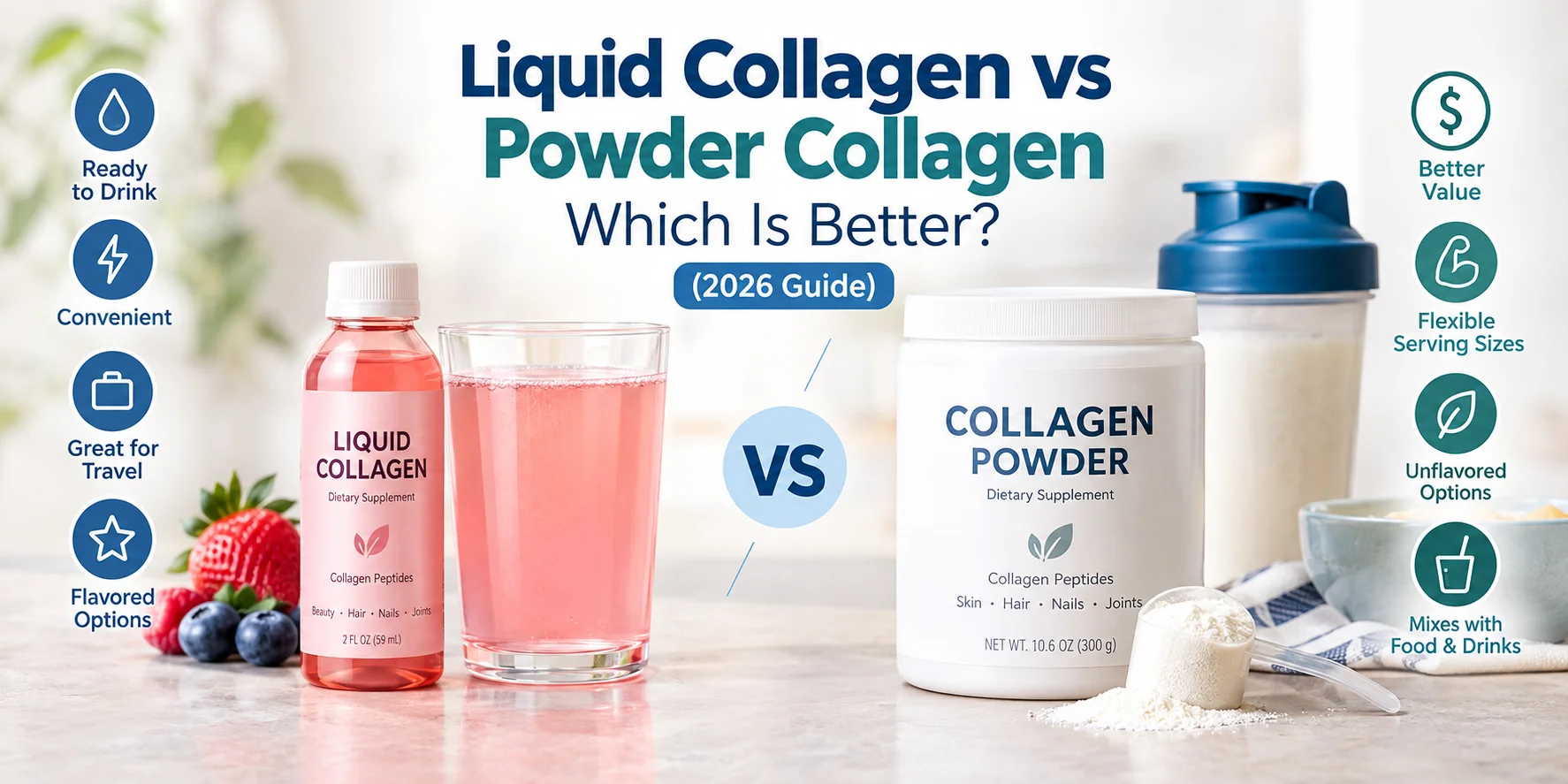
Liquid collagen is convenient and ready to drink, while collagen powder is usually more flexible and can offer better value per serving. Current research supports potential benefits from oral collagen supplementation, particularly for some skin and musculoskeletal outcomes, but that research does not establish that liquid collagen is inherently superior to powder simply because it is liquid.
Let’s compare the two forms so you can decide which one makes more sense for your routine.
Liquid Collagen vs Powder Collagen: Quick Comparison
| Feature | Liquid Collagen | Powder Collagen |
|---|---|---|
| Convenience | Excellent | Good |
| Preparation | Ready to drink | Must be mixed |
| Dosage flexibility | Usually limited | Usually higher |
| Cost per gram | Often higher | Often lower |
| Portability | Very convenient | Convenient |
| Added ingredients | May contain flavors or sweeteners | Often simpler formulas |
| Mixing required | No | Yes |
| Storage | Product dependent | Generally easy |
| Best for | Convenience and consistency | Value and flexibility |
Bottom line: If convenience is your biggest priority, liquid collagen may be the better fit. If you want flexibility, a simple ingredient list, and potentially lower cost per gram, powder collagen may have the advantage.
What Is Liquid Collagen?
Liquid collagen is a ready-to-consume collagen supplement. It commonly comes as a bottled drink, liquid shot, or flavored beverage.
Many products contain hydrolyzed collagen, also called collagen peptides. Hydrolysis breaks collagen proteins into smaller peptide chains that are easier to digest.
Liquid collagen products may also contain ingredients such as:
- Water
- Flavorings
- Sweeteners
- Vitamins and minerals
- Fruit extracts
- Hyaluronic acid
- Other nutritional ingredients
Because formulations vary significantly, don’t judge a collagen product only by whether it is liquid. Check the Supplement Facts label, the collagen source, serving size, and amount of collagen provided.
What Is Collagen Powder?
Collagen powder is usually sold as a dry powder that you mix into a beverage or food.
A typical collagen powder can be added to:
- Water
- Coffee
- Tea
- Smoothies
- Protein shakes
- Yogurt
- Oatmeal
- Other foods and drinks
Many collagen powders contain hydrolyzed collagen peptides and relatively few additional ingredients.
One major advantage is dosage flexibility. Depending on the product instructions, you can measure a serving yourself rather than relying on a pre-portioned bottle.
Liquid Collagen vs Powder Collagen: Does Liquid Absorb Better?
This is one of the biggest questions surrounding the liquid-versus-powder debate.
You may see claims that liquid collagen is automatically absorbed faster or better because it is already dissolved. However, being liquid does not by itself prove that a collagen supplement will produce better results.
What matters is the composition of the supplement, including whether the collagen has been hydrolyzed into peptides and how much collagen you actually consume.
Research on oral collagen supplementation has examined hydrolyzed collagen and collagen peptides in various forms. Recent evidence reviews report potential benefits for skin and musculoskeletal outcomes, but they do not establish a universal advantage for liquid products over powdered products.
So, is liquid collagen absorbed better?
Not necessarily.
A high-quality collagen powder containing hydrolyzed collagen peptides can be an effective option. Likewise, a liquid product can be convenient, but its liquid format alone shouldn’t be considered proof of superior absorption.
When comparing two products, look beyond the word “liquid.”
Which Has More Collagen: Liquid or Powder?
The answer depends on the individual product.
This is important because one serving does not always equal one serving.
For example, one liquid shot might contain a certain amount of collagen, while one scoop of powder may contain a different amount.
“One bottle vs. one scoop”
grams of collagen per serving and cost per gram
What to check on the label
Look for:
- Total collagen per serving
- Type/source of collagen
- Whether it is hydrolyzed
- Serving size
- Additional ingredients
- Suggested daily serving
- Price per container
Benefits of Liquid Collagen
Liquid collagen has several practical advantages.
1. Convenient to Take
You don’t need a shaker, spoon, or glass of water.
Simply follow the product’s directions and consume the recommended serving.
For people who struggle to maintain supplement routines, convenience can be a meaningful advantage.
2. Easy for Travel
Individual liquid shots or bottles can be convenient when traveling.
Instead of carrying a large tub of powder, you can take pre-portioned servings.
3. No Mixing Required
Some people simply don’t enjoy mixing powders into drinks.
Liquid collagen eliminates that step.
4. Often Available in Flavored Options
Liquid collagen products are frequently flavored, which may make them more appealing to people who dislike the taste or texture of unflavored collagen powder.
Liquid Collagen Potential Drawbacks
Liquid collagen isn’t perfect for everyone.
Potential disadvantages include:
- Higher price
- Fixed serving size
- More packaging
- Added sweeteners or flavorings in some products
- Less flexibility when adjusting the amount
Always check the label rather than assuming every liquid collagen product has the same formulation.
Benefits of Collagen Powder
1. Often Better Value
Collagen powder can be more economical when you compare the cost per gram of collagen rather than the price of the container.
This makes powder attractive to people who plan to take collagen regularly.
2. Flexible Dosage
Powder can provide more flexibility because you can measure the recommended amount according to the product instructions.
3. Easy to Add to Foods and Drinks
You can incorporate collagen powder into your existing routine.
For example, you might add it to a morning smoothie or another beverage you already consume.
4. Simple Formulas Are Available
Some powdered collagen products contain primarily collagen peptides with minimal additional ingredients.
However, this isn’t guaranteed. Always read the ingredient list.
Collagen Powder Potential Drawbacks
Possible disadvantages include:
- It needs to be mixed
- Some powders may clump
- Taste and texture vary between products
- You need to measure servings
- It may be less convenient when traveling
Liquid Collagen vs Powder Collagen for Skin
Skin health is one of the most common reasons people take collagen supplements.
Research on oral hydrolyzed collagen has found potential improvements in measures such as skin hydration and elasticity. A 2023 meta-analysis of 26 randomized controlled trials involving 1,721 participants reported significant improvements in skin hydration and elasticity compared with placebo, although the researchers also noted limitations and the need for additional high-quality research.
More recent research remains encouraging but emphasizes that the evidence isn’t perfect. A 2026 systematic review found improvements in several skin outcomes across randomized trials, while also noting that many studies had a high risk of bias.
Is liquid better for skin?
There is not enough evidence to say that liquid collagen is inherently better for skin simply because it is liquid.
If two products provide comparable hydrolyzed collagen peptides, the practical choice may come down to:
- Dose
- Ingredients
- Product quality
- Price
- Personal preference
- Consistency
Liquid Collagen vs Powder Collagen for Joints
Collagen is also widely used for joint health.
A 2025 systematic review and meta-analysis of 11 randomized controlled trials involving 870 participants found that collagen supplementation was associated with improvements in pain and function among people with knee osteoarthritis. However, the studies varied and the findings should not be interpreted as proof that every collagen product will work for every person.
Again, the available evidence generally evaluates collagen supplementation rather than proving that a liquid delivery format is superior to powder.
If joint health is your primary reason for taking collagen, focus on the specific collagen product, dose, evidence, and your individual health needs rather than choosing based solely on whether it comes in a bottle or tub.
Liquid Collagen vs Powder Collagen for Hair and Nails
Hair and nail benefits are frequently mentioned in collagen marketing.
However, consumers should be cautious about expecting dramatic results.
Collagen provides amino acids that the body can use as building blocks for proteins, but that doesn’t mean a collagen supplement will automatically make hair grow faster or prevent hair loss.
If you’re experiencing significant hair loss, brittle nails, or another persistent problem, it’s better to discuss the issue with a healthcare professional rather than relying exclusively on a supplement.
Which Is Cheaper: Liquid Collagen or Powder?
For many consumers, powder collagen can offer better value, but you shouldn’t assume this without comparing actual products.
Here’s a simple calculation:
Cost per gram of collagen
Product price ÷ total grams of collagen = cost per gram
For example, if a product costs $30 and provides 300 grams of collagen:
$30 ÷ 300 = $0.10 per gram
Use this calculation when comparing liquid and powder products.
Don’t compare a $30 bottle with a $30 tub simply because both cost $30. The amount of collagen inside could be very different.
Which Is Easier to Take Every Day?
This comes down to lifestyle.
Liquid collagen may be easier if you:
- Have a busy morning routine
- Travel frequently
- Don’t want to mix supplements
- Prefer flavored drinks
- Want a pre-portioned serving
Powder collagen may be easier if you:
- Already make smoothies or protein shakes
- Drink coffee or tea every morning
- Want to control your serving
- Prefer buying supplements in larger containers
- Want to reduce the cost per serving
The best supplement is ultimately one that fits your routine well enough that you can use it consistently.
What Should You Look for in a Collagen Supplement?
Whether you choose liquid or powder, pay attention to the following.
1. Hydrolyzed Collagen Peptides
Many oral collagen products use hydrolyzed collagen peptides.
Hydrolysis breaks collagen into smaller peptide chains and is common in collagen supplements studied in clinical research.
2. Clearly Stated Amount of Collagen
Don’t rely on vague claims such as “collagen rich.”
Look for the actual amount provided per serving.
3. Transparent Ingredient Label
Choose products that clearly identify their ingredients and serving information.
4. Appropriate Collagen Source
Collagen can come from different sources, including bovine, marine, and porcine sources.
If you have dietary, allergy, or religious considerations, check the source carefully.
5. Third-Party Testing
When available, independent testing can provide additional reassurance about product quality and contents.
6. Avoid Unnecessary Ingredients
If you prefer a simpler supplement, compare ingredient lists and look for products without unnecessary additives, excessive sweeteners, or ingredients you don’t need.
Liquid Collagen vs Powder Collagen: Pros and Cons
| Liquid Collagen | Powder Collagen | |
|---|---|---|
| Convenience | Excellent | Good |
| Ready to use | Yes | No |
| Dosage flexibility | Lower | Higher |
| Travel | Very convenient | Convenient |
| Potential value | Often lower | Often higher |
| Added ingredients | Product dependent | Product dependent |
| Mixing required | No | Yes |
| Flavor choices | Common | Common and unflavored options |
| Best feature | Convenience | Flexibility and value |
Liquid Collagen vs Powder Collagen: Which One Should You Choose?
There’s no universal winner.
Choose liquid collagen if convenience matters most.
Liquid collagen can be a good option if you want something that is ready to consume, easy to carry, and requires no preparation.
Choose powder collagen if value and flexibility matter most.
Powder may be preferable if you want to compare cost per gram, adjust your serving according to the product directions, or mix collagen into foods and beverages.
Choose based on the formula—not the format alone.
This is perhaps the most important takeaway from the comparison.
A high-quality powder isn’t automatically inferior to liquid collagen, and a liquid supplement isn’t automatically superior simply because it is already dissolved.
Frequently Asked Questions
Is liquid collagen better than powder collagen?
Not necessarily. Liquid collagen is more convenient, while powder collagen often provides greater dosage flexibility and may offer better value. There isn’t strong evidence establishing that liquid collagen is universally more effective than powder.
Does liquid collagen absorb faster?
Liquid form alone doesn’t prove faster or better absorption. The characteristics of the collagen itself, including whether it is hydrolyzed into peptides, are important when evaluating an oral collagen supplement.
Is collagen powder as effective as liquid collagen?
A collagen powder can provide collagen peptides just as a liquid product can. The effectiveness of a particular supplement depends on its formulation, amount, quality, and consistent use rather than the physical format alone.
How much collagen should I take per day?
There isn’t one universally established dose for every purpose. Clinical studies have used different amounts depending on the product and health outcome being studied. Follow the manufacturer’s directions unless your healthcare professional recommends otherwise.
Can I mix collagen powder with coffee?
Many collagen powders are designed to be mixed into beverages, including hot drinks. However, follow the specific product’s instructions for preparation and storage.
Does collagen help your skin?
Research suggests that oral hydrolyzed collagen may improve measures such as skin hydration and elasticity in some people. However, results vary, and the evidence has limitations. A 2026 review found promising results while emphasizing the need for better-quality research.
Is liquid collagen worth the extra money?
It can be worth paying more if convenience makes it easier for you to maintain a consistent routine. If you’re primarily concerned about value, compare the cost per gram of collagen before purchasing.
What is the best form of collagen to take?
For many people, the best form is the one that provides an appropriate amount of collagen peptides, fits their dietary requirements, has a transparent ingredient label, and is convenient enough to use consistently.
Final Verdict: Liquid Collagen vs Powder Collagen
So, liquid collagen vs powder collagen—which is better?
For convenience, liquid collagen wins. It’s ready to drink, portable, and requires no mixing.
For value and flexibility, powder collagen often wins. It can be easier to compare by cost per gram, and it can be added to a variety of foods and drinks.
For effectiveness, however, the answer isn’t as simple as “liquid is better.” Current research supports potential benefits from oral collagen supplementation for certain skin and musculoskeletal outcomes, but it does not establish that the liquid format itself provides a universal advantage over powder.
The smartest approach is to compare the actual product: collagen type, hydrolysis, amount per serving, ingredients, quality testing, cost, and your ability to use it consistently.
If you are pregnant, breastfeeding, have a medical condition, take medications, or have allergies to the collagen source, talk with a qualified healthcare professional before starting a new supplement.
This article is for educational purposes only and is not intended to diagnose, treat, cure, or prevent any disease.