
Finding the right large dog harness can make walks safer, more comfortable, and much easier to manage—especially if you have a powerful breed that pulls, lunges, or gets excited around other dogs.
A harness designed for a large dog should do more than simply fit around the body. It should provide secure control without restricting normal movement, distribute leash pressure across the chest, and stay comfortably in place while your dog walks, runs, or explores.
But with so many styles available—including no-pull, front-clip, back-clip, tactical, padded, and escape-proof harnesses—choosing the right one can be confusing.
In this guide, we’ll explain what to look for in a large dog harness, how to measure your dog, which harness features matter most, how a no-pull harness works, and how to tell whether a harness fits correctly.
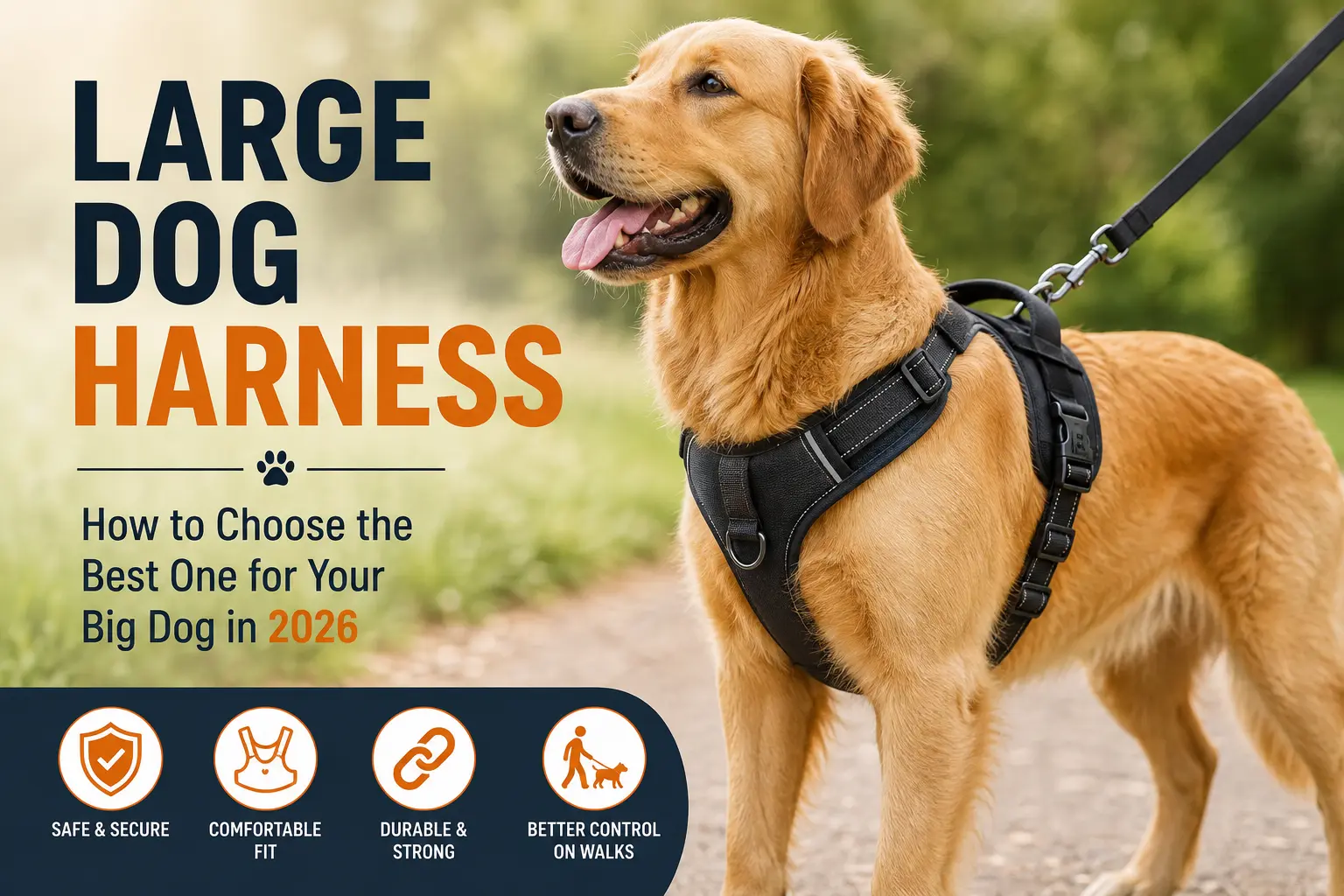
Quick Answer: What Is the Best Large Dog Harness?
The best large dog harness is one that fits your dog’s chest girth and body shape, provides secure leash attachment points, allows unrestricted shoulder movement, and uses durable materials suitable for your dog’s size and strength.
For a large dog that pulls, a front-clip or dual-clip harness can provide additional steering control. For everyday walking, comfort, adjustability, and secure construction are often more important than simply choosing the heaviest harness available.
The key is to choose based on your dog’s measurements and walking behavior—not simply the breed name or weight listed on the package.
What Is a Large Dog Harness?
A large dog harness is a walking and control device designed for bigger breeds and dogs with larger chest measurements.
Unlike a traditional collar, which places the leash attachment around the neck, a harness distributes leash pressure across areas of the dog’s body, primarily around the chest and torso.
Large dogs can generate considerable pulling force because of their size and strength. That’s why the harness needs to be appropriately sized, securely adjusted, and made from materials capable of handling normal walking forces.
However, “large” doesn’t automatically mean the same size for every dog.
A 70-pound Labrador Retriever and a 70-pound Greyhound can have very different body shapes. One may have a broad chest while the other has a narrow torso. This is why chest girth is generally more useful than weight alone when selecting a harness. The American Kennel Club also recommends paying close attention to neck and chest measurements and following the manufacturer’s sizing information.
Why Do Large Dogs Need a Good Harness?
A properly fitted harness can provide several practical advantages for large dogs.
1. Better Walking Control
A large dog that suddenly pulls toward a squirrel, another dog, or an interesting smell can be difficult to control with a leash alone.
A properly designed harness gives the handler more control over the dog’s body.
Front-clip harnesses can be particularly useful for dogs that pull because the leash attachment is positioned toward the front of the chest. When the dog moves forward against the leash, the handler can redirect the dog’s body rather than simply pulling backward.
2. More Comfortable Pressure Distribution
A collar concentrates leash pressure around the neck.
A harness places the attachment point on the dog’s body instead. This doesn’t mean every harness is automatically safer or more comfortable, however. Poorly designed or incorrectly fitted harnesses can rub, restrict movement, or sit in uncomfortable locations.
That’s why fit and design matter just as much as size.
3. Extra Security
Some large dogs are surprisingly good escape artists.
A loose or poorly adjusted harness can allow a dog to back out of it, particularly if the dog has a narrow waist or unusual body shape.
An adjustable harness with multiple adjustment points can provide a more secure fit.
4. Easier Handling in Busy Areas
A harness with a sturdy top handle can provide an additional point of close control when you’re crossing a busy street, entering a veterinary clinic, navigating crowded areas, or dealing with an unexpected situation.
The handle should be treated as a control feature—not as an invitation to routinely lift a heavy dog.
7 Features to Look for in a Large Dog Harness
Not every harness advertised for large dogs is equally useful. Before buying, pay attention to these features.
1. Correct Chest Girth Range
This is one of the most important factors.
Your dog’s weight can help you narrow down options, but the manufacturer’s chest-girth range should determine whether the harness is actually suitable.
Measure your dog around the widest part of the rib cage and compare the measurement with the manufacturer’s size chart.
Don’t automatically select XL simply because your dog is a large breed.
2. Multiple Adjustment Points
Large dogs come in many different shapes.
A German Shepherd, Boxer, Labrador Retriever, Rottweiler, and Great Dane may all require different harness proportions.
Multiple adjustment points allow you to customize the harness around the chest and neck.
A more adjustable harness can also reduce the risk of excessive movement or slipping.
3. Strong Leash Attachment Points
The leash attachment is one of the most important parts of a harness.
Look for securely constructed D-rings and reinforced attachment areas.
If your dog is a powerful puller, don’t assume that a harness is heavy-duty simply because it is marketed as “tactical” or “strong.” Look at the actual construction, hardware, stitching, and manufacturer’s specifications.
4. Comfortable Chest Design
A good harness should sit securely without pressing into the dog’s throat or rubbing aggressively behind the front legs.
Wide, padded contact areas can improve comfort by distributing pressure over a larger surface.
However, more padding isn’t automatically better. Excessive material can make a harness hot or bulky, especially during warm-weather walks.
5. Front and Back Leash Clips
A dual-clip harness provides more versatility.
The back clip can work well for everyday walks when your dog already has reasonable leash manners.
The front clip can provide additional steering for dogs that tend to pull.
Some owners like having both options because they can change the attachment point depending on the situation.
6. Reflective Details
If you frequently walk your dog early in the morning or after sunset, reflective stitching or panels can improve visibility to people and vehicles.
Reflective material shouldn’t replace a leash, proper lighting, or safe walking habits, but it can be a useful additional feature.
7. A Secure Handle
A reinforced top handle can be useful when you need close control of a large dog.
For example, you might use it when:
- Passing another dog
- Crossing a busy road
- Entering an elevator
- Moving through a crowded area
- Getting your dog into a vehicle
- Handling an unexpected situation
The handle should be securely attached to the harness and appropriate for the manufacturer’s intended use.
Large Dog Harness vs. Collar: Which Is Better?
There isn’t one answer for every situation.
A collar remains useful for identification tags and some everyday purposes. However, many owners prefer a harness for leash walking because the leash attachment is positioned on the dog’s body rather than directly around the neck.
For large dogs that pull strongly, a properly fitted harness can give the handler more control.
That said, a harness isn’t a substitute for leash training.
A dog can still pull while wearing a harness. In fact, some dogs may pull enthusiastically in a poorly designed back-clip harness.
The best results usually come from combining appropriate equipment with consistent loose-leash training.
Front-Clip vs. Back-Clip Large Dog Harness
One of the biggest decisions you’ll make is where the leash attaches.
Back-Clip Harness
The leash attaches to a D-ring located on the dog’s back.
Best for:
- Dogs with good leash manners
- Everyday walks
- Casual outdoor activities
- Owners who prefer a simple setup
Advantages:
- Easy to attach
- Comfortable for many dogs
- Convenient for regular walking
- Works well with dogs that don’t pull heavily
Potential downside:
A back attachment may provide less control over a dog that consistently pulls.
Front-Clip Harness
The leash attaches to a ring on the front of the chest.
When a dog pulls forward, the front attachment can help redirect the dog’s body toward the handler.
Best for:
- Strong pullers
- Dogs learning loose-leash walking
- Owners who need additional steering control
Potential downside:
It requires correct adjustment and may take some time for the dog and owner to get used to.
Dual-Clip Harness
A dual-clip harness includes both front and back attachment points.
For many owners, this is the most versatile option because it allows them to choose the attachment point depending on the dog’s behavior and walking environment.
How to Measure Your Dog for a Large Dog Harness
Correct measurement is more important than guessing based on breed.
Here’s a simple process.
Step 1: Measure Chest Girth
Use a soft measuring tape.
Wrap it around the widest part of your dog’s rib cage, generally just behind the front legs.
Keep the tape comfortably snug without squeezing the body.
Record the measurement in inches or centimeters.
Step 2: Measure the Neck
Depending on the harness design, you may also need to measure around the base of your dog’s neck.
Don’t measure high up near the head like you would for a traditional collar.
Follow the specific instructions supplied by the harness manufacturer.
Step 3: Check the Manufacturer’s Size Chart
Never assume that “Large” means the same thing between brands.
One company’s Large may fit a completely different chest range than another company’s Large.
Always compare your dog’s actual measurements with the manufacturer’s chart.
Step 4: Check the Harness After Putting It On
Once the harness is adjusted, check for excessive looseness and excessive tightness.
The American Kennel Club recommends using a two-finger spacing approach when checking the fit of dog gear.
The harness should be secure without digging into the skin.
How Should a Large Dog Harness Fit?
A properly fitted harness should be:
Secure: Your dog shouldn’t be able to easily back out of it.
Comfortable: The straps shouldn’t dig into the skin.
Stable: The harness shouldn’t rotate dramatically from side to side during normal walking.
Unrestrictive: Your dog should be able to walk naturally without the harness interfering with normal shoulder movement.
Appropriately positioned: Straps should stay away from sensitive areas such as the armpits and throat.
Signs Your Harness Is Too Tight
Watch for:
- Deep strap marks
- Skin irritation
- Chafing
- Hair loss around contact areas
- Difficulty moving naturally
- Your dog repeatedly trying to remove the harness
Signs Your Harness Is Too Loose
Look for:
- Harness rotating around the body
- Excessive movement while walking
- Your dog backing out of the harness
- Straps shifting toward the throat
- Large gaps between the harness and body
If you notice any of these problems, stop and readjust the harness before continuing the walk.
What Is the Best Large Dog Harness for a Strong Puller?
If your dog is a strong puller, focus on control, fit, and training rather than simply buying the thickest harness you can find.
A good option for a strong puller may include:
- Front leash attachment
- Dual front and back clips
- Multiple adjustment points
- Secure buckles
- Reinforced leash attachment
- Comfortable chest padding
- Strong webbing
- A secure top handle
A front-clip harness can help redirect a pulling dog, but it doesn’t magically teach the dog not to pull.
For long-term improvement, combine the harness with positive, consistent loose-leash training.
Are No-Pull Harnesses Safe for Large Dogs?
A properly fitted no-pull harness can be a useful walking tool, but the term “no-pull” covers several different designs.
Some use front attachment points to redirect the dog.
Others use straps that change tension when the dog pulls.
The important thing is to understand how the specific design works and make sure it fits your dog correctly.
Avoid assuming that “no-pull” automatically means comfortable or appropriate for every dog.
If a harness causes persistent rubbing, coughing, gait changes, or obvious discomfort, stop using it and consider consulting your veterinarian.
Best Large Dog Harness for Different Situations
The “best” harness depends on what you need it to do.
| Your Dog’s Needs | Harness Features to Consider |
|---|---|
| Everyday walks | Comfortable back-clip or dual-clip design |
| Strong puller | Front-clip or dual-clip design |
| Escape artist | Secure, highly adjustable design |
| Night walks | Reflective material |
| Hiking | Durable construction and secure fit |
| Car travel | A harness specifically designed and tested for vehicle use |
| Powerful working breed | Reinforced construction and appropriate hardware |
| Hot weather | Lightweight, breathable materials |
| Older dog | Easy-on design and secure handling features |
Remember that a harness designed for walking should not automatically be assumed to be a crash-tested vehicle restraint. If you plan to use a harness in a car, check that the manufacturer specifically states it is designed and tested for that purpose.
How to Put a Harness on a Large Dog
Putting on a harness becomes much easier when you follow the same process every time.
1. Introduce the Harness
Allow your dog to sniff the harness before putting it on.
Reward calm behavior.
2. Identify the Front and Back
Make sure you know where the chest panel, neck section, and leash attachment points should sit.
3. Place the Harness Correctly
Position the chest section according to the manufacturer’s instructions.
Make sure straps aren’t twisted.
4. Secure the Buckles
Fasten each buckle and listen for the click.
5. Adjust the Straps
Adjust gradually rather than pulling everything tight at once.
6. Perform a Fit Check
Use the two-finger check and make sure the harness isn’t interfering with movement.
7. Test Indoors
Before going outside, let your dog walk around the house for a few minutes.
Look for slipping, rubbing, twisting, or attempts to escape.
Common Mistakes When Buying a Large Dog Harness
Mistake #1: Choosing by Weight Alone
Weight is useful, but body shape varies significantly between dogs.
Always check chest girth.
Mistake #2: Buying the Largest Size Available
Bigger isn’t necessarily better.
A loose harness can shift or allow a dog to escape.
Mistake #3: Ignoring Shoulder Movement
A harness should provide control without unnecessarily restricting natural movement.
Mistake #4: Assuming Expensive Means Better
Price can reflect materials and construction, but a high price doesn’t guarantee the correct fit.
Mistake #5: Buying Only for Appearance
Color and style are nice, but fit, construction, comfort, and leash attachment should come first.
Mistake #6: Expecting the Harness to Stop Pulling
A harness is equipment, not a replacement for training.
Use it as part of a consistent walking routine.
How to Clean and Maintain a Large Dog Harness
Large dogs can put significant wear on their walking equipment.
Regularly inspect the harness for:
- Frayed webbing
- Loose stitching
- Damaged buckles
- Cracked plastic
- Bent or damaged D-rings
- Worn adjustment points
- Excessive stretching
- Persistent odors or buildup
Follow the manufacturer’s cleaning instructions.
Don’t continue using a harness if an important structural component has become damaged.
For active dogs, it’s also a good idea to inspect the harness before walks rather than waiting until something breaks.
How Often Should You Replace a Large Dog Harness?
There’s no universal replacement schedule.
A lightly used harness may last much longer than one used daily by a powerful dog.
Replace it when you see meaningful signs of wear or when the harness no longer maintains a secure fit.
Dogs can also change shape because of:
- Growth
- Weight gain
- Weight loss
- Muscle development
- Aging
Recheck the fit periodically, especially if your dog’s body condition changes.
Large Dog Harness FAQs
What size harness does a 70-pound dog need?
There is no universal size for a 70-pound dog. Harness sizing depends primarily on the dog’s chest girth, body shape, and the manufacturer’s size chart. Two dogs weighing the same amount can require different harness sizes.
What is the best harness for a large dog that pulls?
A front-clip or dual-clip harness can be a useful option for a large dog that pulls. Look for a secure fit, multiple adjustment points, durable attachment hardware, and comfortable chest construction. Combine the harness with consistent loose-leash training.
Is a harness better than a collar for a large dog?
For leash walking, many owners prefer a properly fitted harness because it places the leash attachment on the dog’s body rather than directly around the neck. The right choice depends on the individual dog, harness design, and walking situation.
How tight should a large dog harness be?
The harness should be snug enough to remain securely positioned without being restrictive. You should generally be able to fit about two fingers between the harness straps and your dog’s body. Always follow the manufacturer’s specific fitting instructions.
Can large dogs wear a harness all day?
It’s generally better to remove a walking harness when it isn’t needed, particularly when your dog is resting or unsupervised. Extended wear can contribute to rubbing, trapped moisture, or coat problems depending on the harness and dog.
What is better for a large dog: front clip or back clip?
A front clip can provide additional steering for dogs that pull, while a back clip is often convenient for dogs with good leash manners. A dual-clip harness gives you both options.
Are padded harnesses better for large dogs?
Padding can improve comfort, especially around areas that experience leash pressure or contact. However, padding should not come at the expense of breathability, mobility, or proper fit.
How do I stop my large dog from pulling?
Use consistent loose-leash training and reward desirable walking behavior. A front-clip or dual-clip harness can provide additional management while you’re training, but equipment alone won’t teach a dog to walk politely.
Final Verdict: Choosing the Right Large Dog Harness
The best large dog harness isn’t necessarily the biggest, thickest, or most expensive model.
It’s the one that fits your dog’s actual body shape, stays securely positioned, allows comfortable movement, and provides the level of control you need.
Before buying, prioritize these features:
- Correct chest-girth sizing
- Multiple adjustment points
- Secure leash attachment
- Comfortable chest design
- Durable construction
- Appropriate clip placement
- Good freedom of movement
- Secure fit
- Reflective details if needed
- A handle if additional close control is useful
Most importantly, measure your dog before ordering.
A correctly fitted harness combined with consistent leash training can make walks much more manageable for both you and your dog.
If you’re shopping for a large dog harness, don’t choose based solely on a product title or breed recommendation. Measure your dog’s chest, compare the manufacturer’s sizing chart, consider your dog’s walking behavior, and choose the design that matches your everyday needs.
Editor’s Tip
If your large dog is a strong puller, start by looking at front-clip or dual-clip harnesses with multiple adjustment points. If your dog already walks nicely on a leash, a comfortable and durable back-clip harness may be all you need.
And remember: the right fit matters more than the label on the package.